So You Want to Get Into AI This Semester. Now What?
AI is more than buzzwords, but knowing where to start can feel overwhelming. Here’s how AI Biz Club’s Fall 2026 events can take you from AI curious to hands-on builder in one semester.
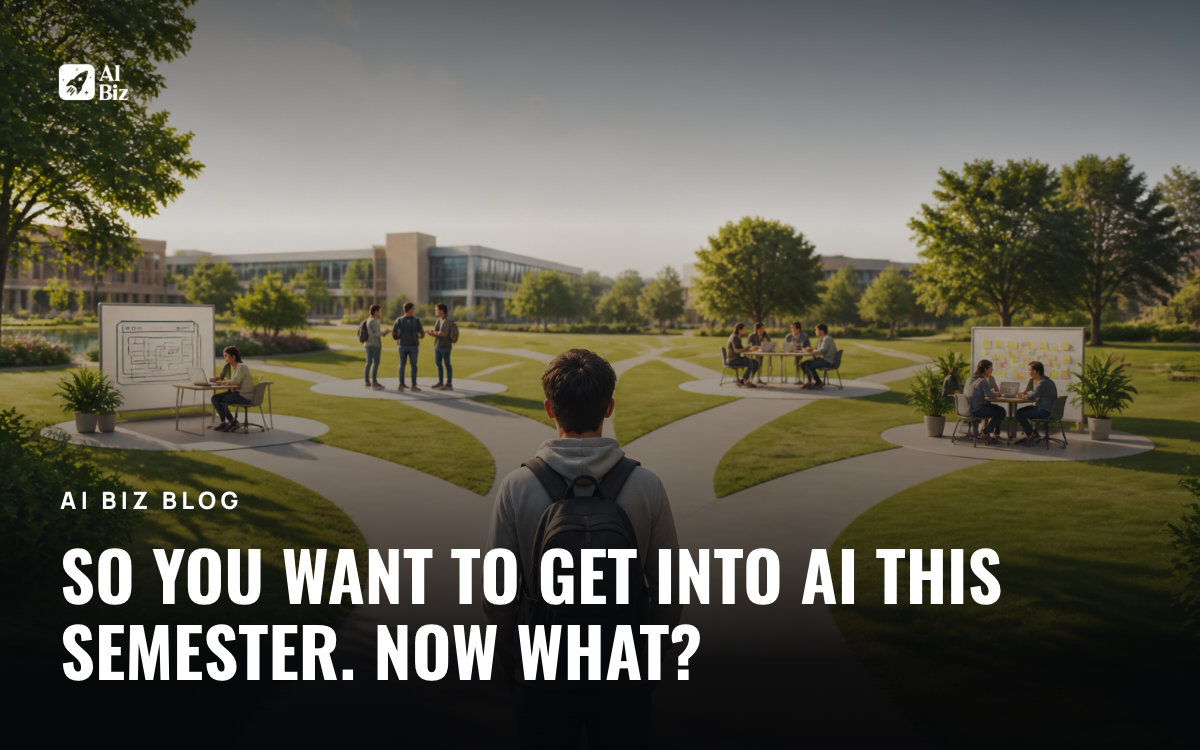
Everywhere you turn, someone is talking about AI. Your TikTok feed is packed with AI-powered tools, recruiters are hunting for candidates with AI skills, and your classmates are casually dropping phrases like “fine-tuning large language models.” The pressure to “know AI” is real, but figuring out how to go from hearing about AI to actually doing something with it? That’s where most students get stuck.
The problem is that “learn AI” is a terrible item to put on a to-do list. A better goal? By December, be able to point to a few things you actually did using AI.
Little steps - Talk to the people hiring. Build something. Learn an AI tool you’ve never used before. Put yourself in a room where you have to solve a problem.
If you’re looking for somewhere to start, here are four things worth putting on your Fall 2026 list.
1. Find Out What Employers Actually Value
Spend enough time online and you’ll find an endless list of “must-have AI skills.” The harder question is which ones actually matter for the career you want.
That’s a good question to take directly to the people doing the hiring.
On September 11, AI Biz Club’s Fall 2026 Kickoff + Recruiter Panel will bring recruiters from JPMorganChase, RealPage, and more to campus.
Rather than trying to reverse-engineer what recruiters want from job descriptions, you’ll have the chance to hear from them directly. What makes a student stand out? Where do AI skills fit into hiring today? What should you be building, learning, or putting on your résumé?
And perhaps more importantly: what doesn’t matter as much as students think it does?
You don’t need to walk away with your entire career mapped out. But knowing what companies are actually looking for can help you spend the rest of the semester building the right things.
2. Put Yourself in a Situation Where You Have to Solve Something
Watching tutorials is comfortable. ✅ Building solutions to a problem you haven’t seen before? Not so easy. ❎
But that’s also where a lot of learning happens.
On October 17, the IBM Z Datathon will challenge students to spend 24 hours building AI for Good at Davidson Auditorium.
Teams will tackle challenges across three tracks: real-time AI for critical decisions, secure AI innovation, and a wildcard track for ideas that go beyond the obvious. There are also prizes on the line: $1,000 for first place, $750 for second, and $500 for third.
Hackathons push you to build, adapt, collaborate, and solve problems as you go, it's e xperience you simply cannot get from following a tutorial.
3. Learn How to Build With AI
A year ago, “building something” could feel like a goal reserved for people with years of programming experience.
That barrier is getting much lower.
During JSOM AI Week on October 24, AI Biz Club is hosting How to Master Claude Code, a hands-on workshop exploring AI-assisted development with Claude Code.
The interesting part isn’t simply learning another AI tool. Tools will change, probably faster than any of us can keep up with them.
What matters more is learning a different way to work: how to give an AI system context, collaborate with it while you build, evaluate what it produces, catch mistakes, iterate, and use it to move from an idea toward something functional.
If coding has always felt intimidating, AI-assisted development can give you a new entry point. Reading about these tools can only take you so far, the real learning starts when you open one and build something.
4. Take an Idea Out of Your Notes App - with NO CODE AI Tools
You know that idea you’ve had for an app, website, business, or random solution to a problem that annoys you?
This is the semester you build it. No-Code tools like Lovable, Bubble, and Glide can help turn an idea into a working app or prototype without building everything from scratch with traditional code.
AI Biz Club is also bringing back building in a format that works for non-coders: UTD’s Biggest No-Code Hackathon, sponsored by Lovable.
The idea is simple: start with a problem, turn it into a product, and see how far you can take it.
No-code and AI-powered building tools have dramatically shortened the distance between having an idea and being able to test it. That doesn’t mean the hard parts disappear. You still have to decide what problem is worth solving, who you’re solving it for, what the product should actually do, and whether your solution makes any sense.
No more waiting until you feel “technical enough” to begin. Build the ugly first version. You can improve it later!
** You Don’t Have to Do It All
Getting into AI doesn’t mean learning every tool, attending every workshop, or becoming an expert overnight. Pick what interests you. Try something unfamiliar. Build something small. The goal isn’t to do everything this semester, it’s to leave with more experience than you started with.
Imagine someone asks you what you did with AI this semester.
Maybe you can say you spoke to recruiters and finally understood which skills were worth focusing on. Maybe you built your first product. Maybe you learned an AI development tool you’d never touched before. Maybe you spent 24 hours solving a problem with a team and discovered that you actually love hackathons.
That’s much more interesting than answering “I use ChatGPT sometimes.”
Pick a tool. Build something. Meet people. Stay curious.
By December, “I’m interested in AI” might mean something very different than it does today.
And if you’re looking for places to start, we’ll see you this fall.
Explore AI Biz Club’s upcoming events and registrations at aibizclub.org/events.