#5 AWS Agentic AI Hackathon Event Highlights

Tuesday, October 28, 2025

AWS Agentic AI Hackathon – Event Highlights

  • Date: October 28th, 2025

  • Time: 3:30 PM - 7:30 PM

  • Venue: JSOM 1.606 (Executive Dining Room)

  • Hackathon Build Window: October 13-23

Event Overview

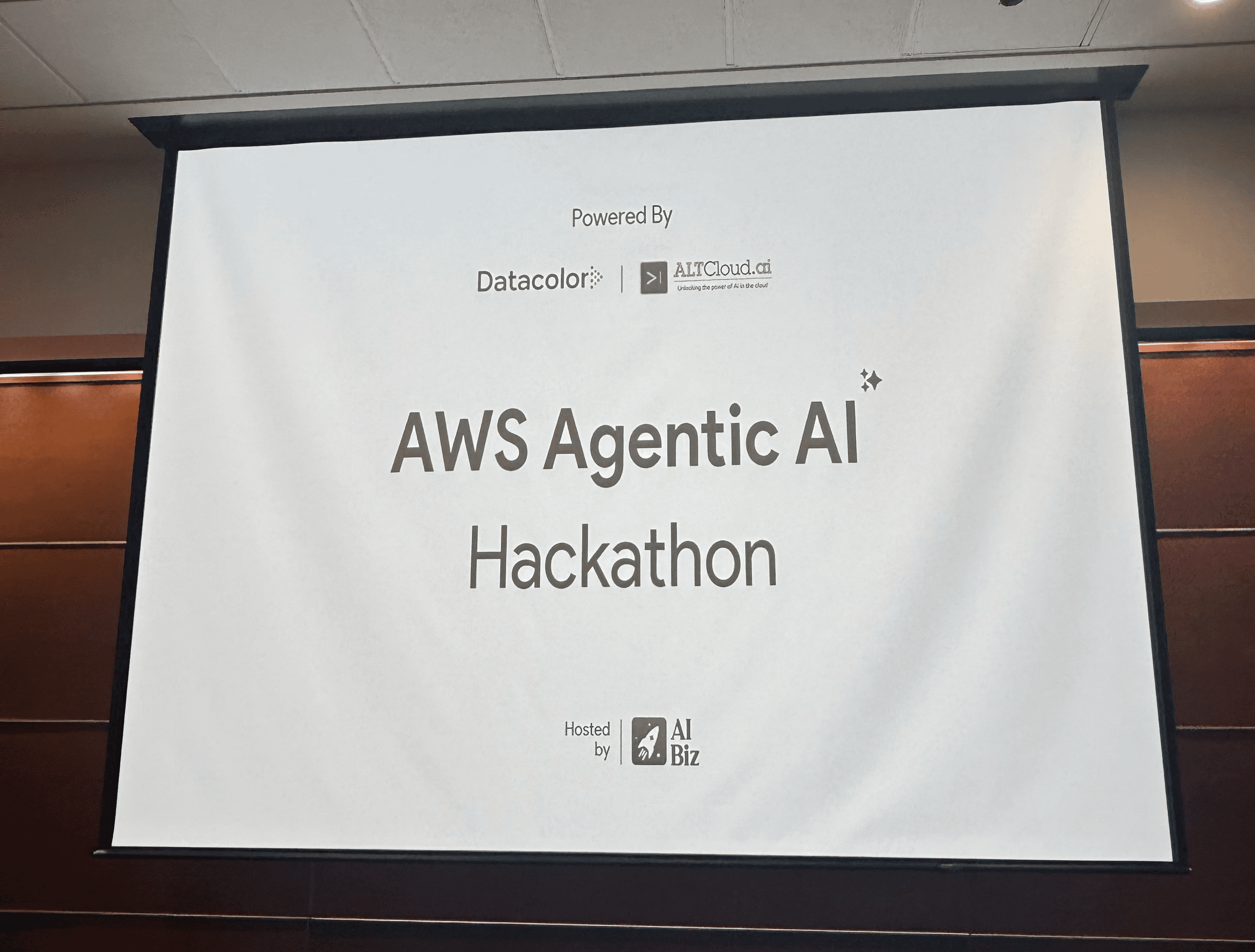
The AWS Agentic AI Hackathon brought together over 100 innovators across 24 teams, all competing to build next-generation AI agents using AWS Bedrock. Over a 10-day build window, students tackled a highly impactful problem

Design an autonomous AI system that helps UTD students navigate career planning with intelligent, data-driven guidance. From job-market reasoning to course mapping to project roadmaps, every system had to be powered by autonomous reasoning loops and multi-agent orchestration.

After intense evaluation by the club’s judges, the Top 4 Finalists advanced to the Finale on October 28th, delivering live demos in front of industry leaders, faculty, and senior technologists.


The AWS Agentic AI Hackathon marked a significant milestone for the AI Biz Club at UT Dallas, bringing together innovation, technical depth, and real-world problem solving in a single, high-impact event. Over the course of a ten-day build window, more than 100 students across 24 teams collaborated to design and implement next-generation agentic AI systems using AWS Bedrock. The hackathon culminated in a live finale event on October 28, where the top teams presented their solutions before an audience of faculty members, industry leaders, and senior technologists.

The challenge posed to participants was both ambitious and deeply relevant. Students were asked to design autonomous AI systems capable of transforming how UTD students approach career planning. Rather than offering generic advice, the solutions needed to intelligently connect job market data, UTD’s course catalog, project recommendations, and personalized learning pathways. At the core of every solution was the requirement to build self-directed, multi-agent systems that could reason, plan, and generate outcomes autonomously using AWS Bedrock. This framing pushed participants beyond traditional chatbot or LLM use cases and into the emerging domain of agentic AI.

In preparation for the hackathon, the AI Biz Club organized a precursor technical workshop designed to ensure participants were well-equipped to succeed. This hands-on session introduced students to agentic workflows, best practices for selecting and orchestrating Bedrock models, designing retrieval pipelines, and integrating action-based APIs. The workshop played a critical role in leveling the playing field, allowing participants from diverse technical backgrounds to enter the hackathon with confidence and a shared understanding of agent-based system design. The impact of this preparation was evident in the sophistication and maturity of the solutions presented during the finale.

The finale event began promptly at 3:30 PM, with the host welcoming finalists, faculty, industry guests, and attendees. The opening remarks outlined the structure of the evening, which included live finalist presentations, a technical keynote, the awards ceremony, and a concluding executive panel discussion. From the outset, the atmosphere in the Executive Dining Room reflected the intensity and excitement of the moment, as teams prepared to showcase weeks of focused effort and collaboration

Four finalist teams advanced to the stage to present their systems. Each team delivered a comprehensive demonstration of their end-to-end solution, highlighting agent collaboration, orchestration logic, retrieval-augmented generation pipelines, Bedrock model integration, and user experience design. The presentations illustrated not only technical capability, but also thoughtful consideration of real-world applicability and student usability.


Team S3entience opened the session with a structured and methodical presentation, demonstrating a clear multi-agent architecture and a refined user journey. Their system emphasized logical reasoning and workflow clarity, setting a strong tone for the remainder of the evening. Team EvoAgents followed with a solution distinguished by robust task-planning loops and disciplined system design. Their implementation showcased strong architectural thinking and effective use of Bedrock for orchestration and reasoning.

The third presentation, delivered by Team NexAI, emerged as a defining moment of the finale. Their solution demonstrated exceptional technical depth, seamless agent coordination, and a highly polished interface. The system’s scalability, autonomy, and clarity of execution clearly reflected production-level thinking, distinguishing NexAI as the strongest overall performer of the event. The final presentation by Team Agentra concluded the showcase with a visually polished and conceptually sound system, marked by clean orchestration and strong interpretability.

While evaluations were finalized, attendees were invited to a keynote session focused on productionizing agentic AI systems. The talk bridged the gap between academic experimentation and enterprise deployment, offering insights into scaling autonomous systems securely, managing orchestration complexity, and transitioning from prototype implementations to real-world AI workflows. This segment provided valuable context for students, reinforcing how the skills demonstrated during the hackathon directly translate to industry practice.


The awards ceremony recognized the outstanding achievements of the finalist teams. Team NexAI was awarded First Place for delivering the most comprehensive, production-ready, and innovative solution of the hackathon. Second Place was awarded to Team EvoAgents, whose architectural clarity and disciplined system design impressed the judges. While only the top two teams received prizes, all four finalists were acknowledged with certificates in recognition of their exceptional work and advancement to the final stage


Following the awards, the event transitioned into an executive panel discussion titled “Agentic Enterprise: A Point of View.” Senior leaders from industry and academia engaged in a wide-ranging conversation on the future of agentic systems, enterprise automation, and the evolving skill sets required for the AI-driven workforce. The discussion offered students valuable perspectives on how agentic AI is already reshaping business processes and how emerging professionals can position themselves for impact in this rapidly evolving landscape. Refreshments were served as attendees continued networking with panelists and peers.

The evening concluded with reflective closing remarks that emphasized the broader significance of the hackathon. Beyond competition, the event served as a platform for collaboration,

experimentation, and community building. The organizing team expressed gratitude to all participants, partners, and supporters, underscoring that the solutions developed during the hackathon represent the beginning of a longer journey. As conversations continued and connections were formed, one message stood out clearly: the future of agentic AI will be shaped by communities willing to build, test, and innovate together—and this hackathon was a powerful step in that direction.


Closing Remarks

The evening concluded with a reflection on the extraordinary talent displayed throughout the competition. The organizing team expressed gratitude to all participants, collaborators, and sponsors. They emphasized that the hackathon was not just a competitive event, but a catalyst for new ideas, new friendships, and new opportunities—demonstrating the growing role of UT Dallas students in shaping the future of AI innovation.

As attendees continued to network and exchange insights, one message resonated clearly: the solutions built during this hackathon are only the beginning. With the rise of agentic AI, the possibilities ahead are vast, and the community that formed around this event will undoubtedly continue to push that frontier forward.